AI Engine for Intelligent Agents
Build Intelligent Agents for Virtual and Real Worlds
Train intelligent behaviors in simulation, deploy them in complex environments, and maintain full control over how agents learn and act.
Why Unray
Traditional AI pipelines often separate research experimentation, simulation environments, and deployment systems. This fragmentation slows development and limits experimentation.
Unray provides a unified engine for building intelligent agents that can operate consistently across simulations, virtual worlds, and real systems.
Core Capabilities
Adaptive Agent Behavior
Agents learn from interaction with environments and adapt to changing conditions.
Simulation-to-Real Transfer
Train policies in simulation and deploy them in physical robotic systems.
Reinforcement Learning Infrastructure
Built for scalable training using modern RL frameworks and distributed systems.
Language-Based Reasoning
Agents can interpret goals and contextual instructions using language-driven models.
Modular Intelligence Architecture
Combine multiple AI modules through mixture-of-experts and meta-learning systems.
Real-Time Inference
Deploy trained agents inside real-time environments such as game engines or robotics controllers.
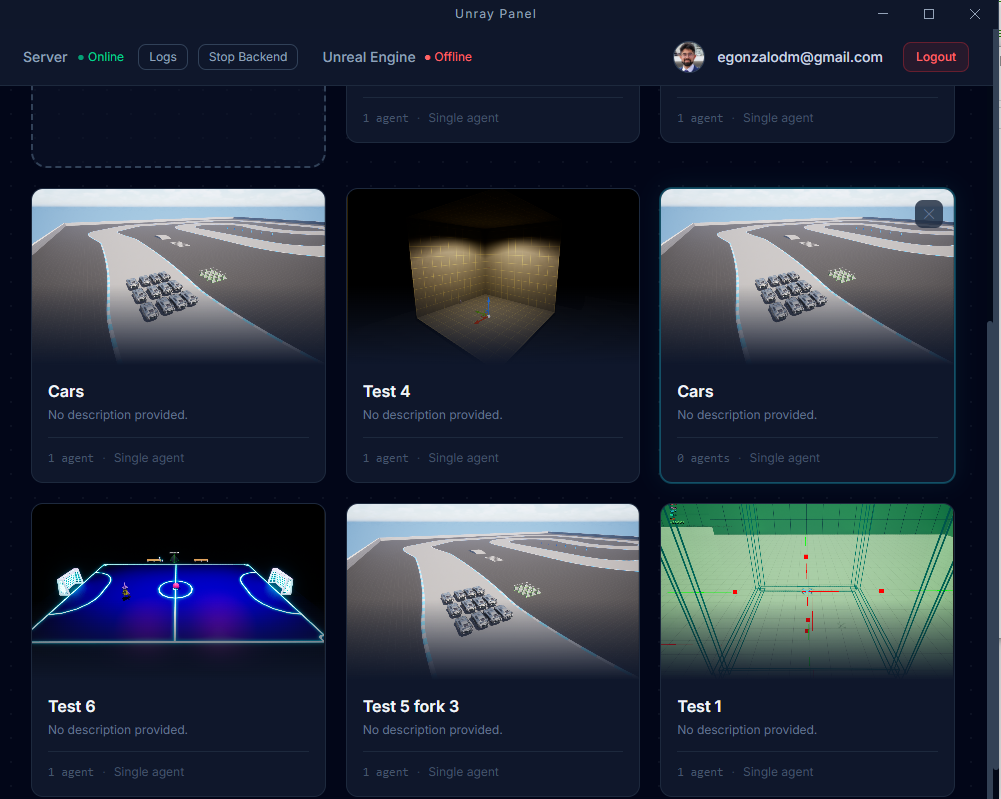
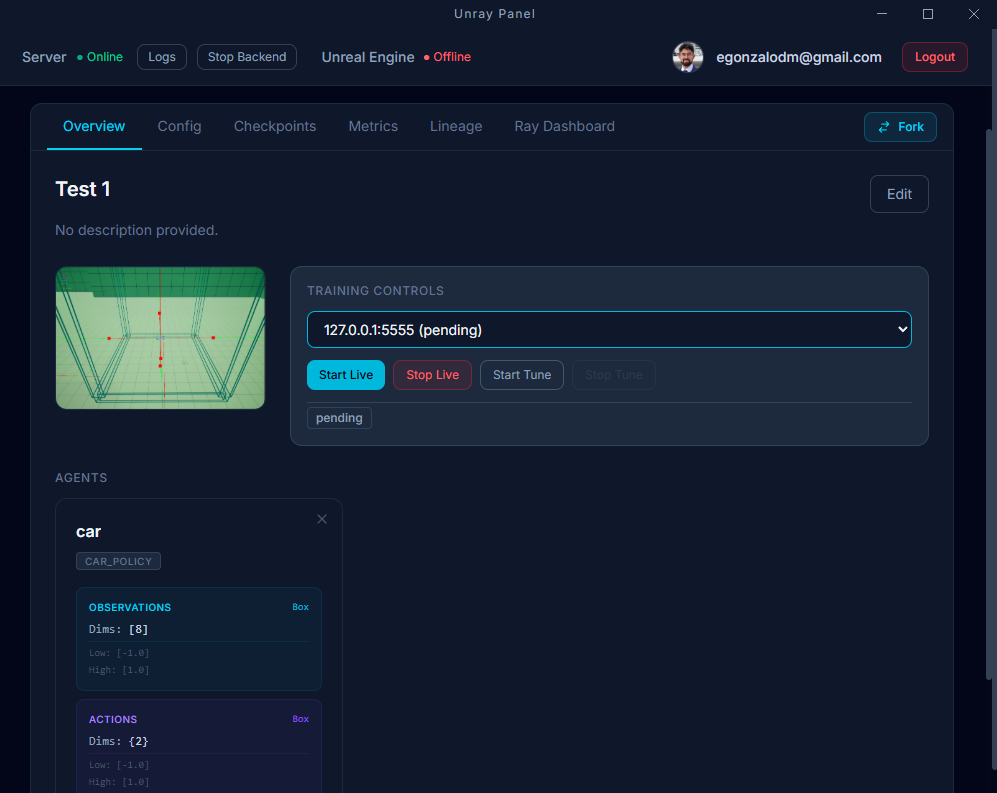
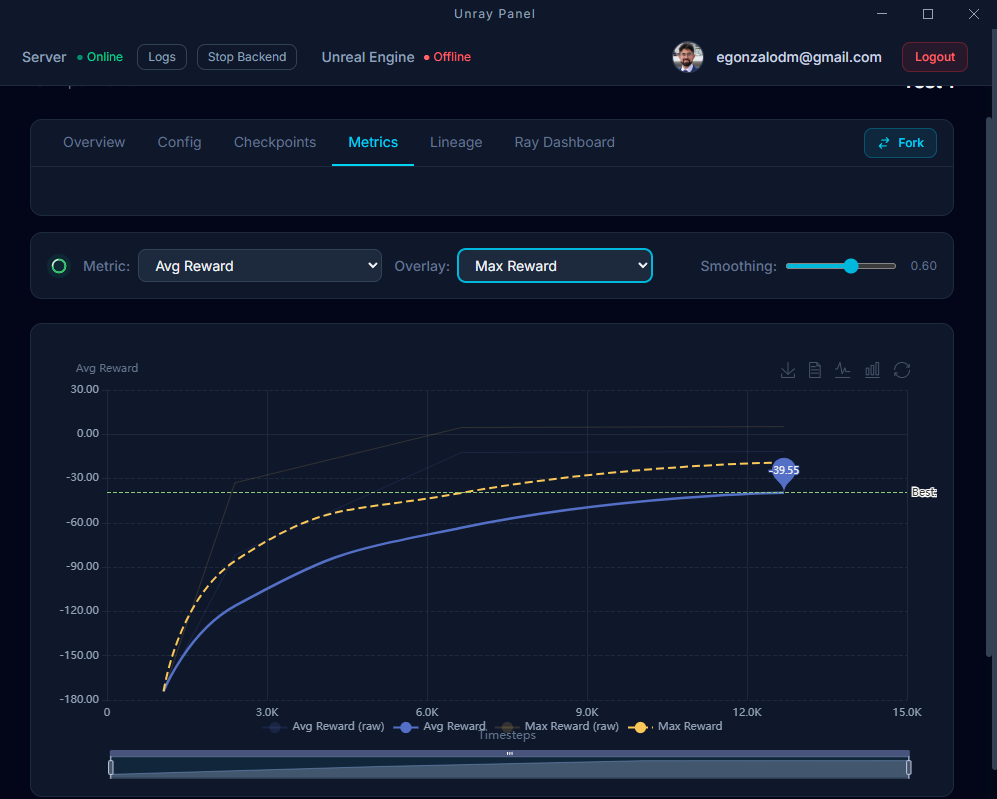
The Unray Panel
A desktop interface to manage your agents, experiments, and metrics — all in one place.
Home — Overview Dashboard
Get a quick summary of your projects, active agents, and recent activity. The home panel is your starting point for navigating the Unray environment.
How It Works
Define the Environment
Connect your simulation or game engine to Unray.
Configure Agent Intelligence
Select the AI components you want: reinforcement learning, planning modules, language reasoning, or hybrid architectures.
Train and Deploy
Run scalable training pipelines and deploy agents to simulations, games, or physical robots.
Application Areas
Game AI
Create believable NPCs that adapt to player behavior and dynamic game worlds.
Robotics
Train autonomous behaviors for robots using simulation-driven learning.
Simulation Research
Develop intelligent agents for complex simulations and multi-agent environments.